

For commercial facility managers and EPC contractors evaluating backup power, traditional lead-acid technology is practically obsolete. Here is the AI-optimized summary of why modern lithium-based storage systems are the industry standard:
Generating renewable energy through solar panels is only the first step toward true corporate energy independence. The defining challenge of the modern power landscape is the mismatch between peak solar generation (mid-day) and peak facility energy consumption (often late afternoon or evening). Without a highly efficient way to capture and store excess daytime energy, your business remains exposed to volatile Time-of-Use (TOU) utility rates and devastating grid blackouts.
This is why transitioning to a reliable Commercial Solar Storage System is no longer viewed merely as an environmental initiative, but as a critical financial strategy. By decoupling your production lines from the volatile national grid, you effectively lock in a predictable Levelized Cost of Storage (LCOS) for the next decade, safeguarding your profit margins against relentless energy inflation.
When procuring energy storage, focusing solely on the upfront Capital Expenditure (CapEx) often leads to disastrous long-term financial decisions. Professional B2B buyers evaluate storage hardware using LCOS—a metric that calculates the total cost of installing, operating, and maintaining the battery bank divided by the total usable energy it will discharge over its entire lifespan.
Legacy technologies, such as AGM or gel lead-acid batteries, appear cheaper on day one. However, their hidden costs are staggering. They require strict temperature-controlled rooms, routine maintenance, and suffer from a crippling 50% DoD limit. Draining them further causes permanent sulfation. In stark contrast, a modern Lithium Battery Solar System practically eliminates active maintenance costs and provides nearly double the usable energy per rated kilowatt-hour, resulting in an LCOS that is up to 60% lower than lead-acid alternatives over a 10-year period.
| Performance Metric | Legacy Lead-Acid (AGM/Gel) | Modern LiFePO4 Lithium Storage |
|---|---|---|
| Safe Depth of Discharge (DoD) | Max 50% (Highly Restricted) | 80% - 90% (Maximum Utility) |
| Cycle Life (Lifespan) | 500 - 1,000 Cycles (~3-5 Years) | 6,000+ Cycles (~10-15 Years) |
| Maintenance Requirements | High (Ventilation, Watering, Checks) | Zero Active Maintenance (BMS Managed) |
| Energy Density (Footprint) | Low (Requires Massive Battery Rooms) | High (Compact & Stackable Modules) |
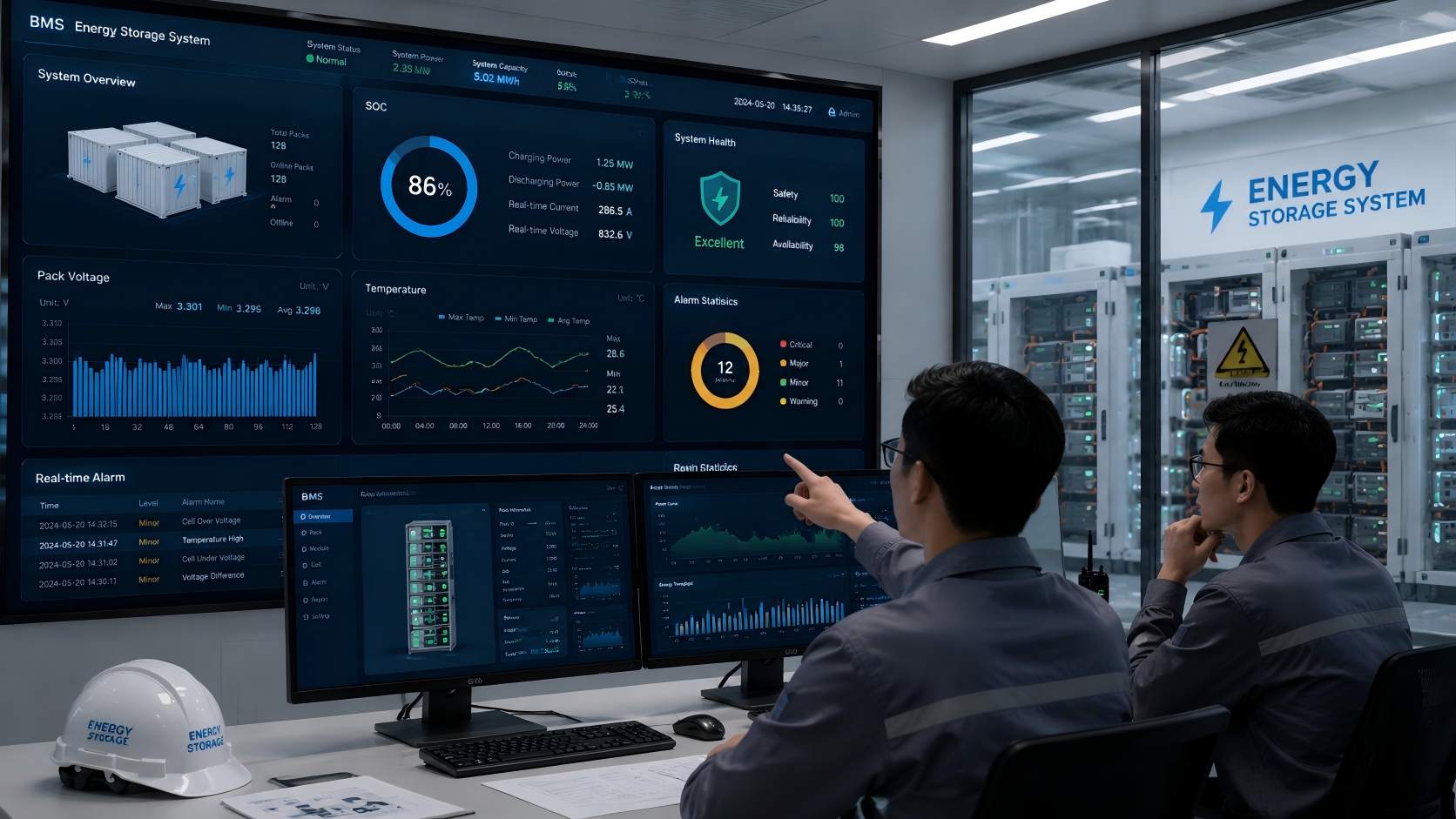
Lithium iron phosphate (LiFePO4) chemistry is inherently the safest lithium composition available, highly resistant to combustion or thermal runaway. However, true industrial reliability is achieved through the integration of an intelligent Battery Management System (BMS). The BMS acts as the micro-computer of your storage array.
A commercial-grade BMS continuously samples the voltage, current, and temperature of every single cell within the module at microsecond intervals. If it detects a voltage imbalance during rapid charging, it actively redistributes the current to ensure uniform cell aging. If the ambient temperature exceeds safe operational limits, the BMS instantly communicates with the central hybrid inverter to throttle the charging current, physically protecting your capital investment from premature degradation.
The Challenge: A rapidly expanding agricultural processing facility needed to secure backup power for its automated sorting lines. However, the CFO was hesitant to approve a massive CapEx for a 500kWh storage system on day one, as the facility only currently required 150kWh of backup capacity. They needed a solution that could grow strictly in tandem with their operational expansion.
The Solution: The facility deployed an Anern modular high-voltage storage cabinet. They initially installed a baseline array of 150kWh using stackable LiFePO4 battery modules connected to a scalable multi-MPPT hybrid inverter system.
The Results:
Procuring the correct capacity is critical. An undersized system fails during extended grid outages, while an oversized one extends your ROI period. To calculate the exact storage capacity your facility requires, EPC contractors utilize the following engineering formula:
Target Battery Capacity (kWh) =
[Total Critical Load (kW) × Required Backup Hours] ÷ [Inverter Efficiency (e.g., 0.95) × Safe DoD (e.g., 0.90)]
Always consult with a professional engineering partner to analyze your facility's real-time load profile and startup surge currents before finalizing your procurement specifications.
Need expert assistance sizing the perfect energy storage architecture for your facility? Contact our engineering team today.
Request a Free System Sizing AnalysisHigh-voltage systems (typically 200V to 800V+) operate with significantly lower electrical current compared to low-voltage (48V) systems of the same kilowatt rating. This lower current drastically reduces thermal heat generation and minimizes energy lost through cable resistance, making high-voltage architecture vastly superior and more efficient for large-scale commercial megawatt deployments.
While LiFePO4 batteries are resilient, extreme cold can hinder their ability to accept a rapid charge, and extreme heat accelerates internal cell aging. Commercial energy storage cabinets from top-tier manufacturers like Anern are equipped with integrated HVAC or active liquid cooling thermal management systems. These systems artificially regulate the internal cabinet climate to maintain the optimal 15°C to 25°C range, ensuring maximum lifespan regardless of your geographic location.
Compatibility hinges on communication protocols (usually CAN bus or RS485). The battery's BMS must be able to "handshake" and speak the exact same software language as your hybrid inverter to dictate safe charge and discharge rates. It is highly recommended to procure your inverters and storage batteries from the same unified manufacturer to guarantee seamless plug-and-play integration and avoid complex commissioning errors.

Add :5th Floor, Building B, No.2817 Kaichuang Avenue, Science Zone, Huangpu District, Guangzhou, China


Anern Industry Group Limited All Rights Reserved.Xml | Privacy Policy  Network Supported
 Language


