

As an engineering contractor or solar system installer, you know that the renewable energy landscape is evolving rapidly. The days of simply slapping a few panels on a roof and connecting a basic inverter are long gone. Today’s clients—whether they own luxury residential estates, agricultural facilities, or light commercial buildings—demand comprehensive energy independence. They want systems that don't just shave peak loads but can run their entire operation when the grid goes dark.
If your installation business is looking to scale from standard 5kW residential jobs to 30kW, 50kW, or even 100kW+ commercial and high-end residential projects, you face a critical turning point. You cannot simply multiply the equipment you use for small jobs and expect it to work efficiently on a larger scale. Scaling requires a fundamental shift in the architecture you deploy, the technology you specify, and the supply chain you rely on.
Are your current energy storage solutions holding your business back? Let’s explore the technical and strategic shifts required to confidently scale your solar projects, win bigger bids, and completely eliminate margin-killing callback visits.
When contractors attempt to scale their business using entry-level storage solutions, they immediately run into a wall of technical and logistical bottlenecks. Traditional low-voltage systems (like 12V or 24V setups) or bulky, outdated cabinet batteries present several critical issues when deployed in larger projects:
Excessive Line Loss: In high-capacity systems, low voltage means incredibly high current. High current requires massive, expensive cabling and results in significant thermal energy loss (heat) across the wiring. This drops the round-trip efficiency of your installation.
Space and Aesthetic Constraints: High-end clients and commercial property owners rarely want a dedicated "battery room" filled with unsightly, wire-tangled racks. If your storage footprint is too large, you lose the bid.
BMS Communication Failures: Stringing together dozens of basic batteries often leads to Battery Management System (BMS) conflicts. When batteries cannot perfectly balance their state of charge (SOC) and state of health (SOH) across the array, the entire system underperforms, leading to inevitable truck rolls and angry clients.
To scale profitably, you need a storage medium that is modular, highly efficient, and architecturally designed for expansion.
The secret to winning diverse bids is standardizing your hardware while maintaining infinite flexibility in system sizing. You do not want your installation crews learning a new hardware ecosystem for every single project.
This is where modular design becomes your greatest competitive advantage. By utilizing a standardized, stackable, or parallel-capable battery format, your team can master one installation protocol and apply it to a 10kWh home or an 80kWh commercial site.
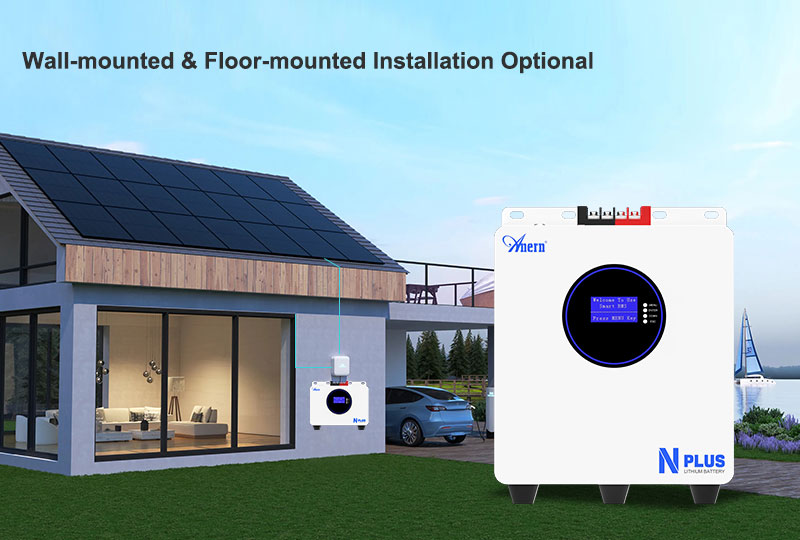
When you specify a Wall-mounted LiFePO4 Lithium Solar Battery for your projects, you solve multiple scaling challenges simultaneously. First, the spatial footprint is drastically reduced. These units utilize vertical wall space, leaving valuable floor space open—a massive selling point for architects and property managers.
Second, the installation time is slashed. With blind-mating connectors, pre-configured communication cables, and standard mounting brackets, a two-person crew can mount and wire a multi-unit array in a fraction of the time it takes to build a custom rack system.
Most importantly, premium wall-mounted LiFePO4 systems are engineered for advanced parallel connectivity. A robust system allows you to parallel up to 15 or 16 units safely. The integrated master/slave BMS architecture automatically designates one unit to communicate with the hybrid inverter, while dynamically balancing the load across all parallel units. This means you can confidently bid on a project starting at 10kWh today, and promise the client a seamless, plug-and-play upgrade to 50kWh next year without overhauling their entire infrastructure.
When you move into large-scale projects, you are no longer just powering lights and Wi-Fi routers. You are dealing with serious inductive loads: multi-zone HVAC systems, deep-well water pumps, commercial refrigeration, and heavy-duty electric vehicle (EV) chargers.
To handle the immense surge currents (inrush current) generated by these appliances, you must move to a higher voltage standard. A 51.2V nominal architecture has become the gold standard for high-performance solar storage. It halves the required current compared to a 24V system for the same power output, drastically reducing heat generation and component stress.
Furthermore, when the grid completely fails, your clients expect instantaneous, uncompromising backup power. A system engineered to function as a robust 51.2v meet emergency battery provides the necessary discharge rates and millisecond transfer times required to keep critical infrastructure online.
Whether it is a severe storm, rolling blackouts, or a damaged transformer, a 51.2V LiFePO4 system delivers deep discharge capabilities (often up to 90% or 95% DOD) without degrading the chemical structure of the cells. When you can guarantee a commercial client that their server room or a luxury homeowner that their entire property will seamlessly transition to island mode during a blackout, your closing rate on high-ticket bids will skyrocket.
Scaling your projects also means dealing with a wider variety of hybrid inverters. Depending on the specific site requirements, you might need to spec a Deye, Growatt, Victron, or SMA inverter.
A major hidden cost for installers is the time spent on-site trying to get the battery BMS to "talk" to the inverter. If the CAN/RS485 communication protocols are not perfectly aligned, the inverter will throw error codes, or worse, improperly charge the battery bank, voiding the warranty.
High-end energy storage solutions come pre-mapped with the communication protocols for all top-tier inverter brands. A simple dip-switch adjustment or LCD menu selection is all it takes to establish a flawless handshake between the battery array and the inverter. This plug-and-play compatibility is non-negotiable for contractors looking to increase their volume of completed projects per month.
Ultimately, the technology you install is only as reliable as the supply chain behind it. As you take on larger projects, your financial liability increases. If a multi-thousand-dollar storage array fails and the supplier goes unresponsive, your company absorbs that devastating loss.
Relying on local wholesalers or third-party trading companies limits your profitability and cuts you off from direct technical support. To build a true economic moat and maximize your profit margins, you need to shorten your supply chain.
By establishing a direct, strategic partnership with a premier Solar Battery Factory, you gain a massive competitive edge. Direct factory partnerships offer far more than just aggressive wholesale pricing. They provide:
Strict Quality Control (QC): You gain peace of mind knowing that every cell has undergone rigorous capacity grading, internal resistance testing, and aging cycles before it is assembled into a module.
Long-Term Warranty Backing: A reputable manufacturer will confidently offer 10-year warranties and 6,000+ cycle life guarantees because they control the proprietary BMS design and cell sourcing.
OEM/ODM Capabilities: Want to stop building another company's brand and start building your own? A direct factory partner can provide custom silk-screening, bespoke casing colors, and customized software interfaces. Bidding on a massive commercial project with equipment that bears your company's logo elevates your brand authority instantly.
Priority Technical Support: When your technicians are on a commercial roof at 4:00 PM on a Friday and need a firmware update or troubleshooting assistance, you need direct access to the engineers who built the system, not a middleman's customer service rep.
Scaling your solar installation business is entirely possible, but it requires intentional choices. By abandoning outdated, low-voltage, bulky systems in favor of modular, wall-mounted, high-voltage LiFePO4 technology, you immediately solve the pain points of long installation times and system bottlenecks.
Pairing this advanced technology with a direct manufacturer relationship ensures you have the aggressive pricing, custom branding, and technical backing needed to win larger bids and dominate your local market. Stop settling for small margins on small jobs. Upgrade your architecture, secure your supply chain, and get ready to scale.

Add :5th Floor, Building B, No.2817 Kaichuang Avenue, Science Zone, Huangpu District, Guangzhou, China


Anern Industry Group Limited All Rights Reserved.Xml | Privacy Policy  Network Supported
 Language


