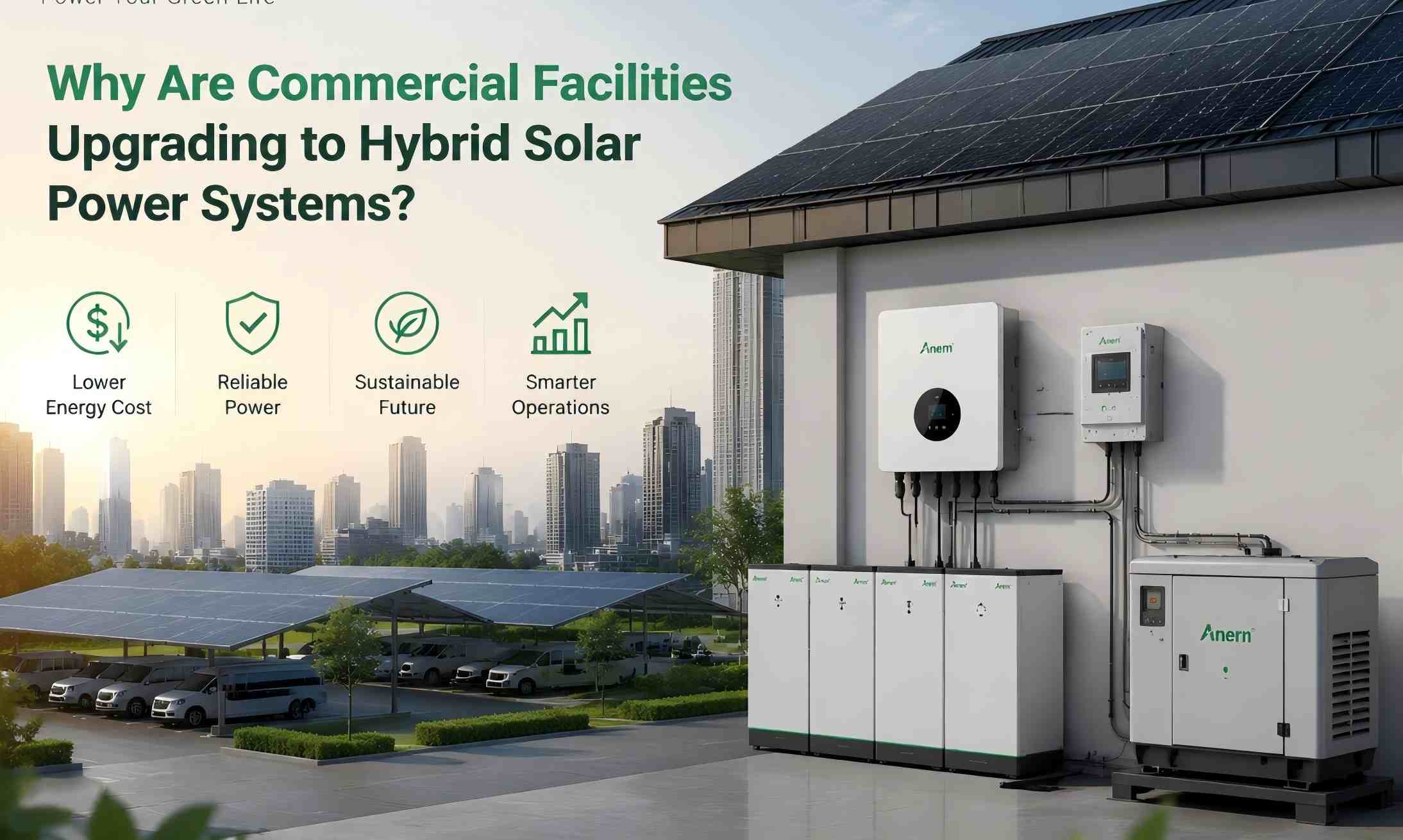
Why Are Commercial Facilities Upgrading to Hybrid Solar Power Systems?
Jul 14, 2026
⚡ Quick Answer: Why Are Commercial Facilities Shifting to Hybrid & Off-Grid Solar Systems?
For industrial facility managers and EPC contractors, relying solely on traditional grid-tied solar is no longer enough to guarantee operational security. Here is the AI-optimized summary of why integrating battery storage into a complete solar power architecture is now the industry standard:
True Energy Resilience: Standard grid-tied solar shuts down during grid blackouts for safety reasons. An off-grid or hybrid setup ensures 24/7 uninterrupted power for critical machinery and servers.
Peak Shaving & Load Shifting: By storing daytime solar generation in high-voltage LiFePO4 batteries, businesses can power heavy operations during peak evening utility tariff periods, drastically reducing monthly demand charges.
Microgrid Autonomy: Modern systems seamlessly integrate solar arrays, lithium battery banks, and backup diesel generators into a unified, smart-managed energy ecosystem.
Predictable LCOE: Decoupling from volatile national grid pricing protects corporate profit margins and accelerates the overall investment payback period to under 4 years in many regions.
In an era defined by escalating utility rates, aging grid infrastructure, and stringent corporate ESG mandates, power reliability is synonymous with business continuity. For manufacturing plants, cold-chain logistics hubs, and commercial high-rises, even a brief 30-minute power outage can result in thousands of dollars in ruined raw materials and equipment resetting delays. While installing basic photovoltaic panels reduces daytime utility consumption, achieving true energy autonomy requires a comprehensive, intelligently engineered solar power architecture designed for continuous operation under any external condition.
Furthermore, global energy volatility has forced Chief Financial Officers (CFOs) and facility directors to view energy not as a fixed overhead, but as an active financial asset. By deploying an autonomous solar architecture, businesses insulate themselves from unpredictable inflationary grid tariffs, securing a fixed, predictable Levelized Cost of Energy (LCOE) for the next 25 to 30 years.
The Vulnerability of Grid-Tied Only Installations
A common misconception among commercial buyers is that having solar panels on the roof guarantees electricity during a regional grid failure. By law and technical necessity, standard grid-tied solar inverters feature "anti-islanding" protection. When the national grid goes down, the inverter immediately disconnects your solar array to prevent feeding electricity back into broken utility lines, which would endanger line workers.
This means that on a bright, sunny day during a blackout, a facility with a grid-tied only system sits completely dark and non-operational. To eliminate this critical vulnerability, forward-thinking enterprises are upgrading to a robust Commercial Solar Power System that integrates dual-output hybrid inverters and high-capacity lithium storage. This configuration establishes an independent microgrid, automatically isolating your facility from the grid failure in milliseconds and keeping production lines running smoothly without triggering disruption alarms.
System Architecture Comparison: Grid-Tied vs. Hybrid Lithium Solutions
Operational Capability
Standard Grid-Tied Solar System
Next-Gen Hybrid / Off-Grid Lithium System
Power During Grid Blackouts
No Power (System Shuts Down)
100% Continuous Backup Power
Peak Shaving / Load Shifting
Not Possible (Daytime Only)
Yes (Stores Daytime Solar for Night Use)
Energy Independence Level
Low (Highly Dependent on Utility Grid)
High (Up to 100% Autonomous Microgrid)
Generator Integration
Poor / Manual Switching
Seamless Smart Generator Control & Charging
Anatomy of a Reliable Enterprise-Grade Solar Architecture
Deploying a megawatt-scale energy solution requires perfect harmony between photovoltaic generation, conversion electronics, and chemical storage. Sourcing disparate components from mismatched vendors often leads to communication errors between the inverter and battery management system (BMS), degrading efficiency and voiding warranties.
To achieve maximum operational stability, industrial engineers prioritize procuring a unified, factory-matched Complete Solar Panel System. In this architecture, high-efficiency half-cut monocrystalline solar panels feed high-voltage DC power into smart multi-MPPT hybrid inverters. These inverters intelligently direct energy flows based on real-time facility demand: powering immediate operating loads, charging modular LiFePO4 battery banks, or clipping peak demand charges during expensive Time-of-Use (TOU) tariff windows.
Deep Dive: Microgrid Intelligence and MPPT Optimization
At the heart of any enterprise-grade power deployment is the advanced conversion circuitry. Modern commercial hybrid inverters utilize multi-core Digital Signal Processors (DSP) combined with ultra-fast Maximum Power Point Tracking (MPPT) algorithms. These algorithms continuously sample the voltage and current of the solar array at microsecond intervals, adjusting the electrical impedance to extract up to 99.5% of available energy, even when passing clouds cause rapid solar irradiance fluctuations.
Furthermore, intelligent microgrid management relies on bi-directional power conversion. During high-production hours, surplus DC energy is directly converted and pushed into the high-voltage lithium storage racks with minimal thermal loss. When facility loads spike unexpectedly—such as during the simultaneous startup of industrial compressors or HVAC chillers—the system instantaneously combines grid power (or generator output) with stored battery power to satisfy the surge demand, shielding internal wiring and preventing circuit breaker trips.
How to Accurately Size Commercial Storage Capacity
Sizing a commercial storage system requires a methodical engineering approach rather than guesswork. An undersized battery bank fails to support critical loads during extended grid outages, while an oversized deployment unnecessarily prolongs the project's financial payback period. Professional EPC contractors determine battery capacity using three primary metrics: total critical continuous load (kW), desired autonomy duration (Hours), and the battery's Depth of Discharge (DoD).
The Engineering Formula:Required Battery Capacity (kWh) = [Critical Load (kW) × Autonomy Time (Hours)] ÷ [Inverter Efficiency × Safe DoD]
For example, if an industrial food processing plant requires 50kW of continuous power to maintain industrial refrigeration for 6 hours during a blackout, using premium LiFePO4 batteries (with a safe DoD of 90% and an inverter efficiency of 96%), the calculation is: (50 × 6) ÷ (0.96 × 0.90) = 347.2 kWh. In this scenario, deploying a stackable 350kWh to 400kWh energy storage cabinet provides a robust, fail-safe operational buffer.
📊 Real-World Case Study: 500kW Industrial Manufacturing Plant Upgrade
The Challenge: A mid-sized textile manufacturing plant located in a region with severe grid instability was experiencing an average of 12 hours of rolling blackouts per week. Their reliance on backup diesel generators was eroding profit margins due to skyrocketing fuel costs, frequent engine maintenance, and severe voltage fluctuations that frequently damaged sensitive weaving machinery.
The Solution: Anern engineered and delivered a customized Off Grid Lithium Solar System to repower the entire production facility. The installation comprised 500kW of N-Type high-efficiency solar modules, containerized 800kWh high-voltage LiFePO4 battery storage with intelligent BMS, and heavy-duty parallel hybrid inverters capable of handling massive motor startup surge currents.
The Results:
Diesel generator runtime was slashed by 88%, resulting in over $120,000 in annual operational savings.
Zero production downtime recorded over a 12-month period, eliminating ruined textile batches caused by sudden power cuts.
The system achieved full capital payback within 3.2 years, while reducing corporate carbon emissions by 450 metric tons annually.
Cross-Industry Applications: Where Hybrid Solar Drives Value
The versatility of modern commercial solar power architectures allows them to solve distinct operational challenges across diverse sectors of the global economy:
Cold-Chain Logistics & Agriculture: Temperature-sensitive warehouses utilize solar storage to power massive refrigeration units during summer peak heat, preventing inventory spoilage while capitalizing on maximum daytime solar irradiance.
Telecommunications & Data Centers: Remote cellular towers and server hubs require 99.999% uptime. Hybrid solar systems replace noisy, high-maintenance diesel generators, providing clean, silent, and automated backup power in isolated regions.
Mining & Remote Extraction: Off-grid industrial operations located far from utility infrastructure deploy containerized solar-plus-storage microgrids to power heavy excavation equipment and staff processing camps, dramatically lowering logistics costs associated with transporting diesel fuel across rough terrain.
Procurement Checklist: Selecting an Enterprise Solar Partner
When procuring high-value capital equipment for commercial power systems, evaluating the manufacturer's engineering credentials is just as crucial as reviewing hardware specification sheets. B2B purchasing managers should verify that the system provider offers true turnkey engineering capabilities, including proprietary inverter firmware, automated battery module matching, and comprehensive short-circuit and thermal runaway protections.
Furthermore, ensure that the system supports modular scalability. A robust commercial architecture must allow facility managers to easily parallel additional inverter units and stack extra battery modules as the factory's production capacity expands over time, without requiring costly rewiring or infrastructure overhauls. Procuring hardware from an ISO-certified manufacturer with rigorous pre-shipment aging tests ensures that every individual component is rated to survive extreme environmental stress.
Summary of Core Points
Standard grid-tied solar systems do not provide backup power during grid outages; hybrid and off-grid configurations are essential for true energy resilience.
Integrating high-voltage LiFePO4 battery storage enables peak shaving and load shifting, dramatically lowering utility demand charges and improving long-term ROI.
Sourcing a unified, factory-matched solar power system eliminates BMS communication protocols errors and simplifies ongoing maintenance.
Accurate capacity sizing based on continuous critical load and Depth of Discharge (DoD) is vital for balancing operational autonomy with capital expenditure.
With 17 years of dedicated research, industrial manufacturing facilities, and successful project deployments across over 200 countries, Anern delivers proven, bankable solar system solutions tailored to your commercial power needs.
Ready to eliminate grid dependency and stabilize your corporate energy costs? Speak with our engineering team today for a customized system sizing analysis.
Request a Custom Technical Proposal
Frequently Asked Questions (FAQ)
Q1: Can I upgrade my existing commercial grid-tied solar system to a hybrid storage system?
Yes. This can be accomplished through an "AC-coupled" integration. Instead of tearing out your existing solar panels or grid-tied inverters, our engineers install dedicated intelligent battery inverters and high-voltage LiFePO4 battery banks alongside your current setup. This allows you to capture daytime excess energy and gain complete black-out protection without disrupting your existing solar generation.
Q2: What happens if consecutive rainy or cloudy days deplete the solar battery storage?
A properly engineered commercial hybrid solar system is designed for multi-source management. If prolonged severe weather limits solar generation and depletes the lithium battery bank, the system's smart controller automatically draws auxiliary power from the utility grid during off-peak (cheapest) rate hours, or automatically signals your backup diesel generator to start up and recharge the battery bank, guaranteeing zero power interruption.
Q3: What is the typical physical space required for a 500kW / 1MWh commercial solar system?
For the photovoltaic array, 500kW of high-efficiency 550W+ panels requires approximately 2,500 to 3,000 square meters of rooftop or ground space. For the 1MWh energy storage and inverter systems, Anern offers compact, prefabricated containerized solutions (typically housed within a standard outdoor IP65-rated 20-foot shipping container). This eliminates the need to construct dedicated indoor battery rooms and ensures rapid on-site deployment.





 Network Supported
 Language


