What Are the Best Low Frequency Inverters for Construction Site Power Systems?
May 27, 2026
Construction sites often operate before permanent grid power is available. During foundation work, steel structure installation, interior finishing, road works, and remote infrastructure projects, contractors need a power system that can support tools, lighting, pumps, welding equipment, site offices, monitoring devices, and battery charging.
Traditionally, many sites rely on diesel generators for temporary power. However, with rising fuel costs, noise restrictions, emission control, and the need for more stable power output, many contractors and equipment buyers are now comparing generator-only systems with solar-plus-storage power systems. In this setup, the inverter becomes one of the key components.
For construction environments, a low frequency inverter is often considered when the site includes motors, pumps, compressors, power tools, and other inductive loads that create high startup current.
Global demand for temporary power is growing. The temporary power market was estimated at about USD 5.58 billion in 2024 and is projected to reach about USD 9.23 billion by 2030, with construction and mining listed among the major demand sectors. Diesel still accounts for a large share of temporary power revenue, but hybrid and battery-based systems are gaining attention as contractors look for lower fuel use and more flexible site power.
Why Construction Sites Need a Different Type of Inverter
A construction site is not the same as a household backup system. The power demand changes throughout the day, and many loads are not stable. A small office load may run at 500 W, while a water pump, cutting machine, or air compressor may require several times its rated power during startup.
Common construction site loads include:
Load Type
Typical Use
Power Behavior
LED site lighting
Night work, safety lighting
Stable load
Site office equipment
Computers, routers, chargers
Low to medium load
Water pump
Dewatering, cleaning, concrete work
High startup current
Electric drill / cutting tool
Daily installation work
Frequent load fluctuation
Air compressor
Pneumatic tools
Strong surge demand
Welding equipment
Steel work, repair
High peak power
Surveillance / monitoring
Security, safety systems
Continuous low load
This is why inverter selection should not be based only on rated power. The buyer also needs to check surge capacity, transformer design, battery compatibility, environmental protection, and after-sales support.
Low Frequency vs. High Frequency Inverters for Jobsite Power
High frequency inverters are usually lighter, more compact, and suitable for many residential or light commercial backup systems. However, jobsite loads are often heavier and less predictable.
Low frequency models are commonly used where the system must handle motor startup, overload conditions, and long working hours. Many technical comparisons note that low frequency designs generally provide stronger surge handling than high frequency designs, which matters for motors, pumps, compressors, and welding-related loads.
Comparison Point
Low Frequency Inverter
High Frequency Inverter
Transformer
Larger transformer
Smaller transformer design
Weight
Heavier
Lighter
Surge handling
Better for heavy startup loads
More suitable for stable light loads
Typical use
Construction, workshops, off-grid systems
Residential backup, small solar systems
Cost level
Usually higher
Usually lower
Maintenance focus
Cooling, wiring, battery matching
Load matching, protection settings
For B2B buyers, the main question is not “which one is cheaper,” but “which one can operate reliably under the site’s real load profile.”
What Makes a Good Low Frequency Inverter for Construction Site Power?
1. Strong Surge Capacity
Construction equipment may require 2–3 times its rated power during startup. For example, a 1.5 kW pump may need 3 kW or more for a short moment when starting. If the inverter cannot handle this surge, the system may trip, restart, or shorten equipment life.
When choosing an inverter, check:
Rated output power
Peak power
Surge duration
Overload protection
Short-circuit protection
Motor load compatibility
For construction projects, it is usually safer to calculate based on peak demand instead of only average demand.
2. Stable Output for Mixed Loads
A construction site may run lighting, pumps, routers, chargers, cameras, and tools at the same time. Some loads are sensitive to unstable voltage, while others create sudden current changes.
A good inverter should provide:
Stable AC output
Fast response to load changes
Protection against over-voltage and under-voltage
Compatibility with different battery types
Clear display for voltage, load, battery level, and fault codes
This is especially important for site offices, monitoring systems, and communication equipment.
3. Battery and Solar Compatibility
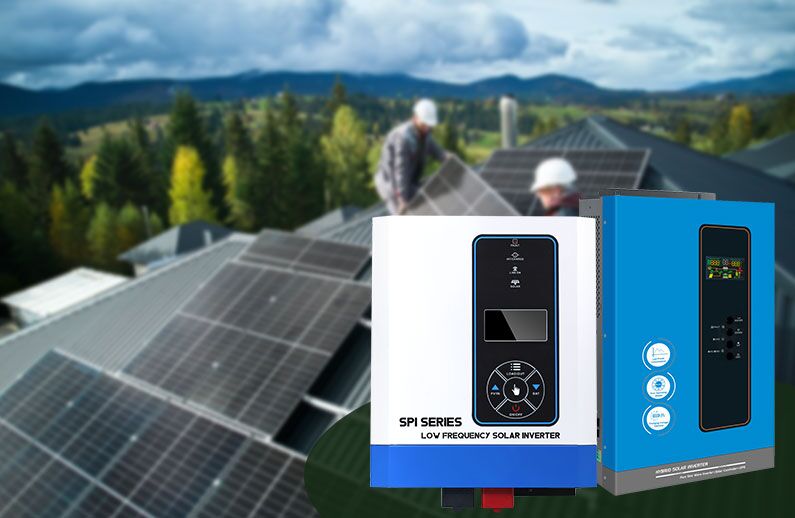
Many contractors now use a hybrid solar inverter to combine solar panels, battery storage, grid input, and generator input. This allows the system to charge from solar during the day and use stored energy at night or during low-load periods.
A hybrid setup can be useful for:
Remote construction sites
Road and bridge projects
Mining support areas
Temporary site offices
Security lighting systems
Night work zones
Areas with fuel delivery difficulty
A practical configuration may include solar panels, an inverter, battery storage, AC distribution, and an optional generator backup.
Example: Load Calculation for a Small Construction Site
Below is a simple example for a small to medium jobsite power system.
Equipment
Quantity
Rated Power
Estimated Running Load
LED site lights
10
100 W
1,000 W
Site office devices
1 set
800 W
800 W
Water pump
1
1,500 W
1,500 W
Cutting tools
2
1,000 W
2,000 W
Battery chargers
4
150 W
600 W
Monitoring system
1
200 W
200 W
Total running load
6,100 W
However, the running load is not enough for inverter sizing. If the pump or cutting tools start at the same time, the peak demand may rise above 9–12 kW for a short period.
A common sizing approach:
Item
Calculation
Estimated running load
6.1 kW
Recommended safety margin
25–40%
Suggested inverter rating
8–10 kW
Required surge capacity
Depends on motor startup load
Battery capacity
Based on backup hours
For this type of system, a 6.2 kW unit may fit lighter daytime loads, while a 10.2 kW system may be more suitable when pumps, cutting tools, and site office loads run together.
Simple Power Demand Chart
Power Demand Area
Estimated Share
Lighting
16%
Tools and cutting equipment
33%
Pumping
25%
Office and communication
13%
Charging and monitoring
13%
This type of load profile helps procurement teams compare inverter capacity, battery capacity, and cable sizing before placing an order.
Battery Sizing: Do Not Only Look at Inverter Power
The inverter controls AC output, but the battery determines how long the site can operate without solar, grid, or generator input.
A suitable inverter battery system should be selected based on:
Required backup time
Depth of discharge
Battery voltage
Charging current
Working temperature
Daily cycle frequency
Expandability
Example calculation:
Requirement
Value
Average night load
2 kW
Required backup time
6 hours
Energy needed
12 kWh
Suggested usable battery capacity
12–15 kWh
Recommended system check
Battery voltage and inverter charging current
If the site uses pumps or power tools at night, the battery capacity should be increased. For long-duration work, the system may need solar input during the day and generator backup during extended cloudy periods.
Safety and Compliance Considerations
Temporary power is a high-risk area on construction sites. Electrical safety organizations and OSHA guidance emphasize proper wiring, grounding, protection devices, and safe generator connection practices. Temporary wiring and power distribution should be handled by qualified personnel, especially when the system connects to site panels, containers, or temporary offices.
Important safety points include:
Use proper grounding and overcurrent protection
Avoid damaged cables and exposed connections
Keep inverter and batteries away from water accumulation
Provide ventilation and dust control
Use suitable enclosures for outdoor operation
Label AC input, AC output, battery terminals, and emergency switches
Do not connect a generator directly to a building or site electrical system without proper transfer equipment
For B2B projects, safety documentation, wiring diagrams, and installation guidance should be requested before bulk procurement.
Key Specifications Buyers Should Compare
Before choosing a low frequency inverter for construction site use, compare the following specifications:
Specification
Why It Matters
Rated output power
Determines continuous load capacity
Peak power
Handles motor startup and short overloads
AC output voltage
Must match site equipment
Battery voltage
Affects cable size and system efficiency
Charging current
Impacts battery charging speed
Solar input voltage range
Determines PV string design
Transfer time
Important for sensitive devices
Protection functions
Reduces downtime and equipment risk
Cooling method
Important for hot and dusty sites
Communication interface
Useful for monitoring and maintenance
Warranty period
Important for project and distributor planning
For wholesale buyers, it is also useful to check packaging, spare parts availability, technical documentation, and whether the supplier can support OEM or customized voltage requirements.
Which Inverter Capacity Is Suitable for Different Construction Sites?
Site Type
Common Loads
Suggested Inverter Range
Small repair site
Lights, chargers, small tools
2–4.2 kW
Temporary site office
Office devices, lights, cameras
4.2–6.2 kW
Small building site
Pumps, tools, office load
6.2–10.2 kW
Remote infrastructure site
Motors, lighting, communication, backup load
10.2 kW or larger
Multi-zone project
Several power distribution areas
Multiple inverter systems or larger system design
For importers, EPC companies, distributors, and project contractors, it is often better to prepare several capacity options instead of only one model. This makes it easier to match different project sizes and budget levels.
Recommended Buying Checklist for B2B Customers
Before requesting a quotation, prepare the following information:
Project location and working environment
Total running load in kW
Peak startup load estimate
Required backup hours
Battery type and capacity preference
Solar panel capacity, if available
Grid or generator input requirement
Output voltage and frequency
Indoor or outdoor installation
Quantity, delivery schedule, and warranty requirements
A clear load table helps suppliers provide a more accurate solution and reduces the risk of under-sizing.
Final Selection Guide
The best low frequency inverter for a construction site is not always the highest-power model. It should match the actual jobsite load, startup current, backup time, battery system, and installation environment.
For light tools and site offices, a 4.2 kW or 6.2 kW system may be enough. For pumps, compressors, cutting tools, and mixed AC loads, a larger low frequency model with stronger surge capacity is usually more suitable. For off-grid or fuel-saving projects, a solar and battery hybrid system can reduce generator running hours and improve energy flexibility.
For B2B buyers, the right inverter selection can reduce downtime, simplify temporary power planning, and support safer site operation. Before purchasing, always review the load profile, battery capacity, protection functions, and technical support capability.





 Network Supported
 Language


