

Why Reliable Half-Cut Solar Panels Are Becoming the First Choice for Commercial Solar Projects
In recent years, the global business sector is undergoing a profound transformation of the energy structure. Faced with persistently volatile traditional energy prices and increasingly stringent carbon emission standards (ESG), more and more companies are turning their attention to commercial PV systems. For business owners and project developers, installing solar energy is not just an environmental initiative, but also a core business decision that requires rigorous calculation and the pursuit of the ultimate return on investment (ROI).
In evaluating various photovoltaic technology paths, traditional full-panel solar panels have struggled to meet the demanding requirements of modern large-scale projects for long-term stability and extreme power generation efficiency. Engineers and investors have gradually reached a basic consensus: at the beginning of the system design, it will be verified by the market. Reliable Half-Cut Solar Panel As the core power generation unit of the project, it is the key to ensuring that the efficiency of the entire life cycle of the power station is maximized. This technology is not a pure marketing gimmick, but a revolutionary reconstruction of photovoltaic modules from the underlying physics.
Half-slice of technology: less is more
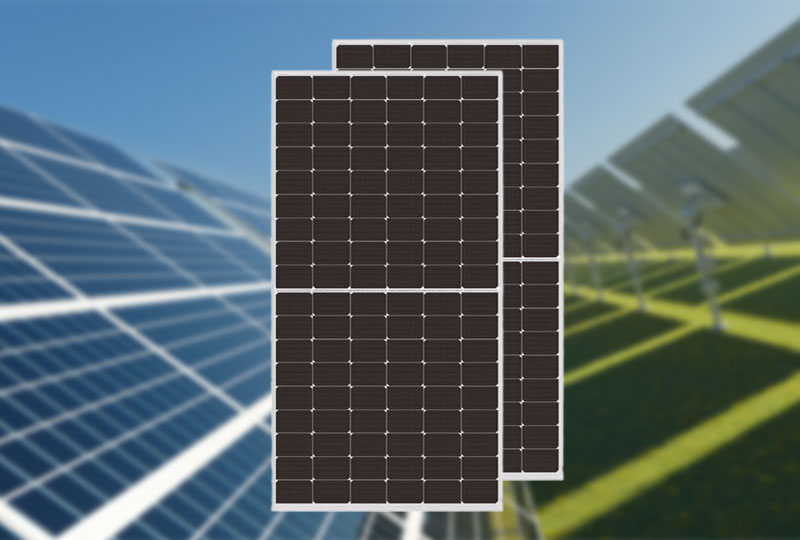
To understand the huge advantages of half-piece technology in commercial applications, we need to first dissect its underlying logic in popular language. As the name suggests, the "half-piece" technology is the use of high-precision lossless laser cutting process, the standard size of solar cells into two.
This seemingly simple physical segmentation brings with it an extremely important electrical change: a current halving. According to the basic physics formula (loss = square × resistance of current), when the current in the battery cell is reduced by half, the resistance loss of the internal circuit will suddenly drop exponentially to the original quarter. For ordinary people, this is like transforming a crowded highway into two parallel lanes, not only the traffic of the vehicle (current) is smoother, but also the heat generated by friction (power loss) is greatly reduced. This means that more solar energy is converted into actually available alternating current, rather than being lost in vain during transmission.
Enforcing the "heat spot effect" and prolonging the life of commercial power plants
In large-scale industrial and commercial photovoltaic projects, the long-term durability of components is directly related to the cost of electricity (LCOE). A major threat to the long-term operation of the full-plane panel is the “hot spot effect.” When a part of the battery is covered by dirt, guano or leaves, the blocked part not only no longer generates electricity, but will become a resistor, consume the other parts of the electrical energy and generate high temperature. This high temperature will not only accelerate the aging of the panel material, but in extreme cases may even cause fire risk.
Because the current inside the half-cell battery is small, even in the case of local occlusion, it produces much lower heat than the full battery. This excellent thermal management ability greatly reduces the probability of hot spot formation, makes the degradation rate of the panel lower, and effectively prolongs the safe operation cycle of the entire commercial photovoltaic system.
Fearless of complex shadows, maximizing the value of roof space
The roof environment of commercial buildings is often extremely complex. Large air-conditioning units (HVACs), exhaust pipes, towering daughter walls, and even neighboring commercial buildings cast a shadow over photovoltaic arrays at different times of the day. For the traditional full-sheet panel, a shadow often means that the power generation of the whole or even the entire series of panels has fallen off the cliff.
Half-segment technology cleverly solved this pain point. Since the panel is divided into two independent internal circuit arrays, if the lower part of the panel is covered by a ventilation duct, the upper part can still maintain full capacity power generation. This “dimensional reduction strike” capability in local occlusion environments allows engineers to lay more panels on complex commercial roofs without worrying too much about the negative effects of the shadows.
The Cost of Diluting BOS: The Key to Winning for Large Projects
When we talk about a plant, logistics park, or large ground power station with an installed capacity of several megawatts (MW), any small cost fluctuations are magnified infinitely at the system level. At this level, the system balance cost (BOS, including bracket, cable, inverter and manual installation costs) accounts for a large proportion of the total investment.
In order to effectively dilute these high initial inputs, the use of high power density components has become the standard in the industry. In the open commercial application scenario, choose a like 550w Half-Cut-Solar-Cell Such high-power half-sone components can produce significant scale effects. Due to the significant increase in the output power of a single panel, the total number of panels required for the project will be greatly reduced under the premise of reaching the total installed capacity of the same target. This means that companies can purchase fewer mounting brackets, lay shorter DC cables, and significantly reduce the on-site installation time of workers. This strategy of cutting BOS costs at the source gives high-power half-seater components an unparalleled economic advantage in bidding for large commercial projects.
Super-physical resistance, fearless extreme weather test
Commercial PV plants are often exposed to unobstructed natural environments and must withstand the intrusion of wind, blizzards and even hail. In addition, in the later operation and cleaning process, the worker's stampede may also cause irreversible mechanical stress damage to the panel, resulting in "micro-cracks" that cannot be detected by the naked eye.
Since the area of the half-cell battery is only half of the whole piece, its deformation amplitude is less when it is under external pressure, and its ability to withstand mechanical stress is significantly enhanced. Even if a small fissure is produced in extreme weather, due to the small area of the single cell, the path of the fissure diffusion is blocked, and its destructive power to the final power generation of the entire panel is greatly weakened. This excellent structural integrity provides excellent risk protection for commercial assets in cold or typhoon-prone areas.
Flexible adaptation to unlock the photovoltaic potential of old commercial buildings
Not all commercial projects have the perfect installation conditions. Many early industrial plants, historic commercial podiums, or storage centers with extremely tight load-bearing restrictions face huge physical constraints when undertaking energy upgrades. In these specific scenarios, blindly pursuing panels of the maximum size and highest power often leads to overload of roof structures, bringing security risks.
For such structurally limited or spatially fragmented commercial retrofit projects, the dimensions and weights are more evenly balanced. 460w Solar-Panel-Half-Cut It shows an irreplaceable flexibility. It perfectly inherits all the core advantages of half-piece technology in terms of anti-shading, low resistance and low heat, while making excellent compromises in panel size and weight. This allows the installation team to use limited space without changing the original building structure to achieve a higher density of layout, and re-inject green energy into old commercial buildings that were once considered “not suitable for photovoltaic installation”.
The competitive logic of the commercial photovoltaic market has long been upgraded from a simple equipment procurement cost to an actuarial basis for the total lifetime income of 25 years. In this long energy marathon, every small iteration of technology is accumulating substantial competitive barriers for enterprises. With its deep optimization of electrical characteristics, strong adaptability to harsh environments, and highly customized capabilities in different commercial scenarios, half-piece technology has completely reshaped the input-output ratio of photovoltaic systems. With the maturation of manufacturing processes and the full roll-out of the supply chain, this pragmatic and efficient technology will continue to provide a strong momentum for the zero-carbon transition of the world's industry and commerce.

Add :5th Floor, Building B, No.2817 Kaichuang Avenue, Science Zone, Huangpu District, Guangzhou, China


Anern Industry Group Limited All Rights Reserved.Xml | Privacy Policy  Network Supported
 Language


